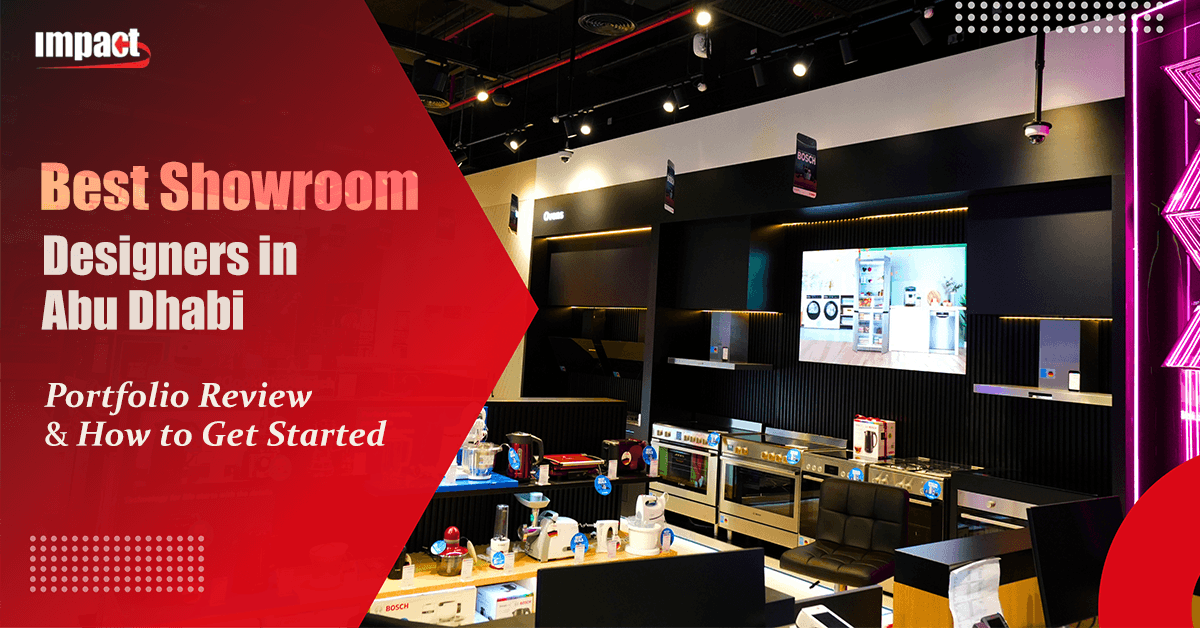
Best Showroom Designers in Abu Dhabi: Portfolio Review & How to Get Started
Abu Dhabi’s commercial landscape is evolving rapidly, with premium retail corridors, automotive showrooms, and experience-driven brand environments redefining how businesses engage customers. In this environment, a showroom is no longer just a display space. It is a strategic asset that influences perception, trust, and conversion. In competitive environments like Abu Dhabi, the quality of a showroom often determines whether a customer engages with a brand or walks past it.
From high-visibility locations along Sheikh Zayed Road, Abu Dhabi, to premium retail developments like Yas Mall, showroom environments are expected to meet both aesthetic and operational excellence.
According to retail and consumer market insights by PwC Middle East, businesses across the region are increasingly investing in physical environments that enhance customer experience and brand differentiation. Their 2026 findings highlight that developers and operators are modernising retail environments in the GCC to integrate experiential concepts, digital capabilities, and mixed-use formats.
As competition intensifies, the role of these well-designed showroom spaces is becoming central to how brands attract, engage, and convert customers in high-value markets like Abu Dhabi.
For most businesses, the difference between a high-performing showroom and an average one comes down to how effectively design, execution, and customer experience are integrated into a single strategy.
This guide reviews what defines top showroom designers in Abu Dhabi, how to evaluate portfolios, and how to get started with the right partner.
Why Choosing the Right Showroom Designer in Abu Dhabi Matters
In Abu Dhabi, showroom projects operate within a structured regulatory and commercial environment.
Projects must align with:
- Municipality regulations
- Civil Defence approvals
- Developer-specific fitout guidelines
- Brand compliance standards
A poorly selected design partner can result in:
- Approval delays
- Budget overruns
- Execution gaps between concept and reality
For businesses investing in high-value environments, selecting from the best showroom designers in Abu Dhabi ensures that design intent translates into build quality, compliance, and commercial performance.
In many cases, the cost of selecting the wrong partner is not immediately visible during construction. It appears later in the form of delayed approvals, inconsistent finishes, operational inefficiencies, and reduced customer engagement.
For leadership teams, this transforms showroom design from a creative decision into a governance decision. The right partner reduces execution risk, while the wrong one introduces compounding inefficiencies that affect both timeline and financial performance.
What Defines the Best Showroom Designers in Abu Dhabi
Not all design firms operate at the same level. The best showroom designers combine creative capability with execution discipline.
1. Portfolio Relevance
A strong portfolio is not about quantity. It is about relevance.
Evaluate:
- Industry-specific projects
- Scale and complexity of work
- Retail vs showroom experience
- Automotive, electronics, or luxury segments
Designers with relevant experience reduce risk and improve execution accuracy.
2. Design-to-Execution Capability
One of the biggest gaps in showroom projects occurs between design and execution.
Top firms:
- Design with buildability in mind
- Coordinate with engineers early
- Align materials with feasibility
This ensures that the final output matches the original concept.
3. Authority Approval Expertise
In Abu Dhabi, approvals are not optional.
Leading showroom designers:
- Understand submission requirements
- Prepare compliant drawings
- Coordinate with authorities
This reduces delays and avoids costly rework.
4. Material and Manufacturing Knowledge
Material selection affects both aesthetics and durability.
Top designers:
- Recommend materials based on lifecycle cost
- Understand fabrication limitations
- Align finishes with brand positioning
This is critical in high-end showroom environments.
5. Timeline and Project Management Discipline
Execution speed is a competitive advantage.
The best showroom designers in Abu Dhabi:
- Provide realistic timelines
- Align design with procurement
- Maintain structured project tracking
6. Understanding of Customer Behaviour in Physical Spaces
The best showroom designers go beyond architecture and aesthetics. They understand how customers interact with physical environments.
This includes:
- Entry-point visibility
- Movement flow inside the showroom
- Product interaction zones
- Decision-making touchpoints
In high-performance showrooms, layout decisions are based on behavioural patterns rather than assumptions. Designers who understand this can influence how long customers stay, what products they engage with, and how smoothly they transition toward purchase decisions.
This capability is especially important in Abu Dhabi’s competitive retail environment, where customer attention is limited, and first impressions are critical.
Portfolio Review: What Decision-Makers Should Look For
Reviewing a portfolio requires more than visual appreciation.
Visual Quality vs Functional Design
A visually impressive showroom does not guarantee performance.
Ask:
- Does the layout support customer flow?
- Are products displayed effectively?
- Is lighting aligned with the product type?
Consistency Across Projects
Strong designers maintain consistency across multiple projects.
Look for:
- Uniform quality
- Attention to detail
- Brand alignment
Evidence of Real Execution
Many portfolios showcase concepts rather than completed projects.
Verify:
- Completed installations
- Real project images
- Client references
Sector-Specific Expertise
Different industries require different approaches.
- Automotive showrooms require spatial planning and lighting precision
- Electronics showrooms require display integration
- Lifestyle retail requires experiential design
Choosing a designer with sector expertise improves results.
Another important factor often overlooked during portfolio evaluation is scalability.
Businesses planning multi-location expansion must ensure that the design approach can be replicated across different sites without losing consistency. This requires not only design capability but also production standardisation and execution discipline.
Designers who rely heavily on bespoke, one-off solutions may struggle to deliver consistency across multiple locations. In contrast, firms that combine design with manufacturing insight can replicate environments efficiently while maintaining brand integrity.
For growing brands, scalability is not optional. It is a core requirement.
Showroom Design Process in Abu Dhabi: Step-by-Step
Understanding the process helps executives plan effectively.
Step 1: Requirement Analysis
- Brand objectives
- Product categories
- Target audience
Step 2: Concept Design
- Layout planning
- Material selection
- Brand integration
Step 3: Design Development
- Detailed drawings
- MEP coordination
- Authority-ready documentation
Step 4: Approvals and Compliance
- Municipality submissions
- Civil Defence approvals
- Developer coordination
Step 5: Execution and Installation
- Fabrication
- Site work
- Quality control
Step 6: Handover and Launch
- Final inspection
- Snagging
- Operational readiness
In practice, these stages often overlap rather than operate sequentially.
Experienced showroom designers align design development, procurement planning, and authority submissions within a single coordinated timeline. This reduces idle time between phases and allows projects to progress more efficiently.
For example, long-lead materials can be identified during the design phase and secured early, preventing delays during construction. Similarly, authority submission drawings can be prepared alongside design development, reducing approval timelines.
This integrated approach is one of the key differentiators between average and high-performing showroom design partners.
Cost Considerations for Showroom Design in Abu Dhabi
Showroom design costs vary depending on complexity and scale.
Typical influencing factors:
- Design complexity
- Material selection
- Digital integration
- Custom fabrication
Indicative Cost Ranges
| Category | Cost Range |
| Basic showroom | AED 400 – AED 700 per sq ft |
| Mid-range showroom | AED 700 – AED 1,100 per sq ft |
| Premium showroom | AED 1,100 – AED 1,800+ per sq ft |
Strategic Insight
Cost should be evaluated alongside:
- Timeline
- Quality
- Lifecycle performance
Lowest cost rarely delivers the best value.
It is also important to consider cost in relation to revenue potential rather than as a standalone number.
A well-designed showroom can increase customer engagement, improve product visibility, and support higher conversion rates. These factors directly influence revenue generation over the lifecycle of the showroom.
In contrast, cost-saving decisions that compromise layout efficiency, lighting quality, or material durability can negatively impact both customer perception and operational performance.
For this reason, experienced decision-makers evaluate showroom investment based on long-term value rather than initial expenditure alone.
How Showroom Design Impacts Business Performance
Showroom environments directly influence how customers perceive a brand and make purchasing decisions.
Factors such as lighting, layout, and spatial organisation affect:
- Customer dwell time
- Product interaction
- Perceived product value
In high-investment sectors such as automotive and electronics, these factors can significantly impact conversion rates.
According to retail customer experience research by Deloitte, physical store environments significantly influence customer perception, engagement, and purchase decisions. Their latest findings suggest that up to 40% of a brand’s value perception is driven by non-price factors—such as the quality of the physical environment and the ease of interaction—reinforcing the importance of showroom design as a strategic revenue driver rather than a purely visual investment.
For businesses operating in Abu Dhabi, where competition is high and customer expectations are elevated, showroom design becomes a critical component of the overall sales strategy rather than a secondary consideration.
Common Mistakes When Choosing Showroom Designers
Even experienced teams make errors during selection.
1. Choosing Based on Visuals Alone
Ignoring execution capability leads to mismatched outcomes.
2. Underestimating Authority Approvals
Delays often originate from compliance issues.
3. Ignoring Manufacturing Capability
Outsourced production increases risk.
4. Lack of Project Visibility
Poor reporting leads to unexpected delays.
Impact Advertising: Showroom Design & Execution in Abu Dhabi
Impact Advertising delivers showroom environments across Abu Dhabi and the UAE, combining design interpretation with execution capability. Businesses can explore their full-service capabilities on the Impact Advertising official website.
Operating from Emirates Industrial City, Al Sajaa, Sharjah, UAE, the company supports projects across the GCC with integrated services, including:
- Showroom design development
- Authority coordination
- In-house manufacturing
- Installation and execution
Drawing on more than 30 years of industry experience, Impact Advertising has delivered retail environments for global brands including LG, Siemens, ASUS, Haier, HP, Carrefour, MSI, Lenovo, TEKA, Hitachi, and Hisense.
This integrated approach ensures alignment between design intent and final execution, reducing delays and improving project outcomes.
Businesses planning showroom projects in Abu Dhabi can explore detailed capabilities on the Abu Dhabi showroom solutions page.
How to Get Started with a Showroom Project
For decision-makers ready to proceed, the process should begin with structured planning.
1. Define Objectives Clearly
Understand whether the showroom is for:
- Sales
- Brand experience
- Product demonstration
2. Set Budget and Timeline
Align financial and operational expectations early.
3. Shortlist Qualified Designers
Focus on relevance, not just reputation.
4. Review Portfolio and Execution Capability
Verify completed work, not just concepts.
5. Engage Early with Execution Partners
Integrated planning reduces risk.
In addition to these steps, early engagement with a qualified showroom design partner can significantly improve project outcomes.
Involving designers during the planning phase allows for better alignment between business objectives, design strategy, and execution feasibility. It also helps identify potential risks related to approvals, procurement, and timeline constraints before they impact the project.
This proactive approach is often what separates successful showroom projects from those that experience delays and budget overruns.
Another critical consideration is long-term adaptability.
Showrooms must evolve alongside product updates, marketing campaigns, and changing customer expectations. Flexible design systems that allow for reconfiguration without major structural changes provide significant long-term advantages.
This includes modular display units, adaptable lighting systems, and scalable layouts that can accommodate new product lines.
Designers who incorporate flexibility into the initial design reduce future renovation costs and improve the longevity of the showroom investment.
For businesses evaluating showroom investments in Abu Dhabi, early consultation with an experienced execution partner can significantly reduce risk and improve project outcomes.
Final Perspective
Selecting from the best showroom designers in Abu Dhabi is not a design decision alone. It is a strategic business decision that impacts capital investment, brand perception, and revenue generation.
In a competitive market where physical environments influence customer decisions, the quality of showroom design directly affects commercial performance.
For businesses ready to invest in showroom development, the focus should be on choosing partners who combine creativity with execution discipline, ensuring that design vision translates into measurable business outcomes.
Frequently Asked Questions
1. Who are the best showroom designers in Abu Dhabi?
The best showroom designers in Abu Dhabi combine design expertise with execution capability, authority approval knowledge, and manufacturing coordination. This ensures that showroom concepts are delivered accurately, on time, and in compliance with local regulations.
2. How long does a showroom project take in Abu Dhabi?
Typical timelines range from 8 to 16 weeks, depending on approvals, complexity, and scale.
3. What is the average showroom design cost in Abu Dhabi?
Costs typically range between AED 400 and AED 1,800+ per sq ft based on design and material complexity.
4. Should I choose design-only or design-and-build firms?
Integrated design-and-build firms reduce coordination gaps and improve execution efficiency.
5. What should I check before hiring a showroom designer?
Evaluate portfolio relevance, authority, experience, manufacturing capability, and project management structure.